Hiring the right Salesforce professional can have a significant impact on your business. The right person can streamline operations, improve adoption, automate processes, build better solutions, and help your organization get substantially more value out of Salesforce.
The wrong hire? That can get expensive quickly, cause internal frustration, doubt in the value of Salesforce and ultimately do more harm than good for the overall business.
Here’s where many companies go wrong: They start trying to hire, write a job description, talk to a recruiter and put up a job posting before they’ve really figured out what they need.
What happens?
Someone quits, so you need a replacement. A major project comes up, so you need someone with Salesforce experience. Your company purchases Salesforce or acquires/merges with a company, and suddenly you realize someone needs to know Salesforce and own it and start looking to hire full-time.
Or maybe you’re considering bringing in a Salesforce consulting partner to help with a larger initiative because it feels out of scope for your internal team.
Whatever the situation, it’s tempting to jump straight into writing a job description, contacting recruiters, or reaching out to consulting companies.
I’d encourage you to slow down first. We’re slowing down so we can go fast and get the perfect candidate.
If you want to hire the best Salesforce talent for your organization, you need to understand the role, the business need, and the type of professional who will be successful in your environment.
Here’s how to approach it.
Step 1: Understand What You Actually Need
Before you think about job titles, certifications, years of experience, or salary ranges, start by understanding the business need.
What’s the immediate need? What is the primary reason you’re thinking “we need to hire”What problem(s) are you trying to solve or what outcome are you trying to achieve?
Now identify secondary value this professional could bring. What other tools, integrations, systems does your company use? What if you hired someone who could bring expertise with those too? Do you have a backlog of projects or tasks that never seem to make the priority list, what are those and what skills do they require?
You might find that you need someone who can listen, organize, prioritize and communicate effectively as much as you need someone who can implement custom technical solutions in your Salesforce org.
And who within your organization is going to benefit from this person’s work?
This is where you should start talking to stakeholders. I didn’t say managers, executives and decision makers, I said stakeholders. Stakeholders can be anyone from the new customer support and sales rep all the way up to the CFO needing custom reporting metrics for end of month financial records.
Identify the departments, teams, and individuals who will be impacted by this role. Find the subject matter experts who understand the processes, challenges, and opportunities within those departments.
For example:
- Sales: Do you need someone to improve sales processes, manage automation, build reporting, or help sales representatives get more value out of Salesforce?
- Customer Service: Are there opportunities to improve case management, automate support processes, or improve the customer experience?
- Marketing: Do you need someone who understands marketing automation, lead management, campaign attribution, or integrations?
- Operations: Are you looking to streamline internal processes, improve data quality, or connect different departments through Salesforce?
- Leadership: Do you need better visibility into business performance, reporting, forecasting, or strategic technology decisions?
Don’t assume that the person requesting the hire has the complete picture, or that the one big project should dictate the talent needed or that the person who quit had the exact skills you should look to replicate. You can find someone who is better, but understanding your need is the key, it’s like building the foundation to your home before buying the living room furniture.
The person who manages Salesforce might have one set of expectations. The sales director might have another. The people using Salesforce every day might have an entirely different perspective.
Bring those perspectives together.
Your goal is to develop a clear understanding of what this person will actually be responsible for, what problems they’ll solve, and what success will look like.
Once you understand the need, you can start translating it into the qualifications you’re looking for.
Step 2: Define the Talent and the Environment They’ll Be Working In
Now that you understand the business need, it’s time to define the type of professional who can deliver the outcomes you’re looking for.
This is where certifications, experience, technical skills, and professional background start to matter.
But don’t just create a laundry list of qualifications like every other job description, make it your own because it is.
Think about which skills are absolutely necessary, which ones are beneficial, and which ones can be learned after someone joins your organization.
For example, are you looking for someone who:
- Has experience with Salesforce Sales Cloud, Service Cloud, or another specific Salesforce product?
- Has hands-on experience building Flows, developing Apex, or implementing integrations?
- Has worked in your particular industry?
- Understands business analysis, process improvement, and stakeholder management?
- Has experience managing Salesforce implementations or working with consulting partners?
- Holds specific Salesforce certifications?
These are all useful considerations, but they should be driven by your actual business requirements.
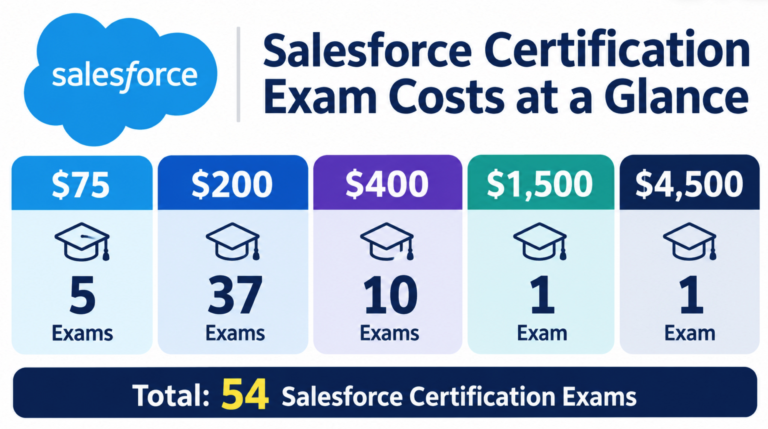
A certification might demonstrate foundational knowledge, but a certification alone DOES NOT demonstrate that someone can successfully solve your particular business problems or has any experience with them.
Likewise, someone with ten years of Salesforce experience isn’t automatically a better candidate than someone with two years of highly relevant experience. I’ve seen employees work an internal role for 5 years for one company doing more or less the same job year after year while I’ve seen individuals working at a consulting firm and get more process experience, business exposure and diversified expertise in just 1 year.
Hire for the skills and experience that will help you accomplish your goals, not simply the qualifications that look impressive on a resume.
Don’t Forget About Culture and Working Style
There’s another piece of this equation that often gets overlooked: What kind of person will thrive in your organization?
Most job descriptions have some variation of:
“We’re looking for a motivated self-starter who thrives in a fast-paced, challenging environment.”
What does that actually mean?
It doesn’t tell a candidate anything meaningful about what it’s like to work with your team.
Instead, tell your story.
Think about how your organization actually operates.
- Do you have a Kevin or a Karen that can be challenging to work with?
- Do you need a strong communicator who can speak to the new support person hired last week as well as the Executive asking questions about the investment in Salesforce?
- Do you enjoy collaborating regularly, getting everyone together for brainstorming sessions and problem-solving?
- Do you prefer people who work independently and come together for weekly meetings or when something needs attention?
- Do you expect your Salesforce professionals to research solutions, explore new technologies, and bring new ideas to the table?
- Is mentoring and knowledge sharing an important part of your culture?
- Do you want someone who actively participates in the Salesforce community, attends events, and stays current with the latest releases?
- Or do you prefer someone who gets deeply familiar with your internal processes, understands how your business operates, and focuses on continuously improving what you’ve already built?
None of these approaches is inherently better than another.
The important thing is understanding which environment you’re creating and finding someone who will thrive in it.
Some Salesforce professionals love exploring new technologies and bringing outside ideas into an organization. Others prefer becoming deeply embedded in a business, understanding its operations, and becoming the go-to expert for its Salesforce environment.
Both can be excellent hires. But they’re not necessarily the same person.
The more clearly you can communicate your working environment, expectations, and culture, the better your chances of attracting someone who genuinely fits and genuinely wants to work for you versus just wanting a job.
Turn This Into a Better Job Description
At this point, you should have a much clearer picture of what you’re looking for.
You can now translate that information into:
- The responsibilities and expected outcomes of the role.
- Required technical skills and Salesforce experience.
- Preferred certifications and industry experience.
- Communication, collaboration, and problem-solving expectations.
- Your organization’s working environment and culture.
- What success looks like in the first 6–12 months.
This information also becomes incredibly valuable if you decide to work with a recruiter or Salesforce consulting partner.
Rather than simply saying, “We need a Salesforce Administrator,” you’ll be able to explain what that person needs to accomplish, what skills they need, and what kind of professional will be successful.
That makes it much easier for someone helping you find talent to identify the right candidates.
Step 3: Determine How Much Work You Actually Have
Now that you understand the role and the type of professional you’re looking for, there’s one very important question to ask yourself:
Do we actually have enough work to justify hiring someone full-time? Or do we simply not know of alternative hiring options?
Let’s put some numbers behind this.
For the sake of this exercise, let’s assume a full-time employee works 40 hours per week for 50 weeks per year.
That’s approximately 2,000 working hours annually.
So, ask yourself:
Where are those 2,000 hours going to come from?
What projects, responsibilities, ongoing maintenance, business initiatives, and support requirements will this person be responsible for throughout the year?
And more importantly, are those responsibilities going to continue for the foreseeable future?
When a Full-Time Salesforce Professional Makes Sense
A full-time hire can make a lot of sense when you have consistent, ongoing demand for Salesforce expertise.
For example:
- Your organization has multiple departments relying on Salesforce every day and every day brings new requests, ideas and innovative changes.
- You have a continuous pipeline of enhancements, automation, and process improvement projects.
- You need someone consistently managing your Salesforce environment, users, data, and administration.
- Your Salesforce roadmap is substantial enough to support ongoing development and implementation work.
- You need someone embedded in your business who understands your operations, stakeholders, and long-term goals.
You don’t necessarily need to have every hour mapped out in advance. But you should have a reasonable understanding of the workload and responsibilities that will keep this person productive.
And here’s something worth considering: You don’t necessarily need 2,000 hours to justify a full-time hire.
Maybe you can confidently identify 120 hours of work every month. That’s still a substantial, recurring need.
The point isn’t that 2,000 hours is a strict hiring threshold. It’s that you should be able to identify a consistent business need that justifies bringing someone on full-time.
What If You Don’t Have 2,000 Hours?
This is where I think many companies overlook options. It feels like a full-time hire is all that is readily available and that’s fair. I mean most recruiters and staffing agencies only work to fill full-time roles. It’s also true that if you haven’t worked with a high quality “fractional” or “freelance” talent then you may not have experienced beneficial alternatives.
Let’s say you have 10, 20, or even 25 hours of Salesforce-related work every week.
You have projects to complete, processes to improve, automations to build, and ongoing improvements you’d like to make.
But you can’t realistically identify 30+ hours of work every week.
Does that mean you should hire someone full-time anyway?
No – in fact there are much better alternatives to get even higher quality talent than you’d find full-time for a lower price.
It might mean you’re a great candidate for fractional or freelance Salesforce talent. Don’t limit yourself by assuming that means less valuable or less dedicated talent, because it’s not true.
You can get the exact same talent that’s working at a big consulting firm charging you $200/hour for $90/hour buy working with them directly. The issue is most companies don’t know how to work with that talent directly and instead hop on the hiring hamster wheel.
Instead of hiring someone for 40 hours a week, you could bring in an experienced Salesforce professional for the specific number of hours you need.
Maybe that’s 5 hours a week. Maybe it’s 20. Maybe it fluctuates between 5 and 20, that’s perfectly fine.
The important thing is that you have access to the skills and experience you need without committing to a full-time position that you might struggle to keep productive.
And this isn’t just for smaller companies.
Organizations of all sizes can benefit from bringing in fractional Salesforce professionals when their needs don’t justify a full-time employee.
You don’t need a full-time employee to get full-time results from the right Salesforce professional.
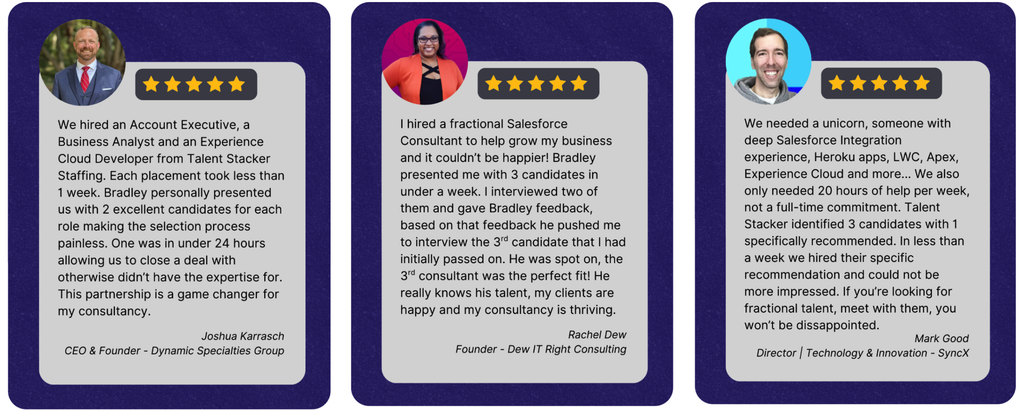
These are all real companies that brought in fractional or freelance Salesforce talent.
Step 4: Choose the Right Hiring Approach
Now that you understand what you need, the type of talent you’re looking for, and how much work you actually have, you’re in a much better position to decide how to bring that talent into your organization.
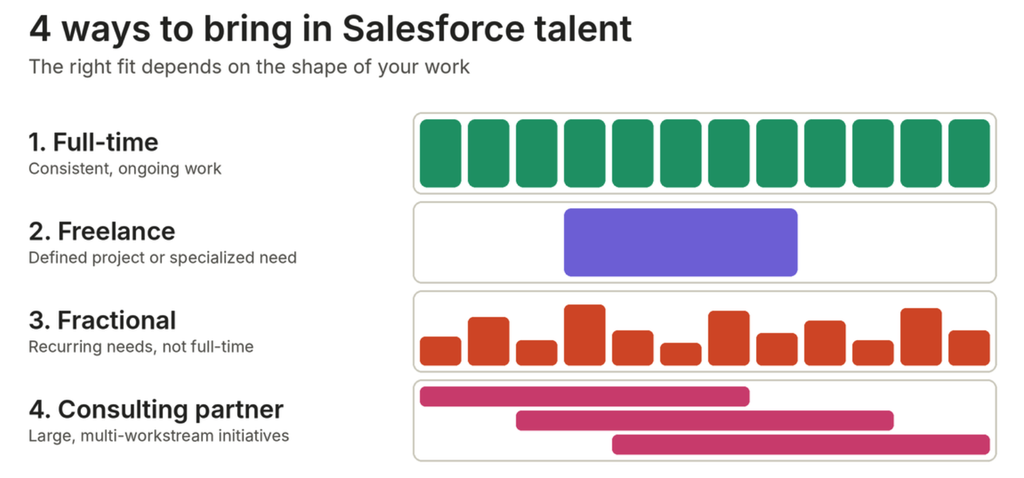
There are four primary approaches worth considering.
1. Hire a Full-Time Salesforce Professional
Best when you have consistent, ongoing work that requires someone embedded in your organization.
This person becomes part of your team, develops an understanding of your business, and takes ownership of your Salesforce environment and initiatives.
2. Hire a Freelance Salesforce Professional
Best when you have a defined project, a specific deliverable, or a temporary need for specialized expertise.
You can bring the exact talent in for the exact work you need completed without creating a long-term employment commitment.
3. Hire Fractional Salesforce Talent
Best when you have recurring Salesforce needs but not enough work to justify a full-time employee. Think of this like getting all of the benefits of a full-time employee without paying for hours you don’t need.
A fractional professional can provide ongoing expertise and support for an agreed-upon number of hours each week or month.
This can be particularly valuable when you need someone experienced who can help guide your Salesforce strategy, manage ongoing improvements, or provide consistent technical support.
4. Engage a Salesforce Consulting Partner
Best when you have a larger implementation, complex technical requirements, multiple workstreams, or a need for a team with diverse areas of expertise.
A consulting partner can bring together architects, developers, administrators, project managers, and other specialists to deliver a larger initiative. You’re typically going to pay 2x-4x that of a full-time, freelance or fractional hourly rate but it’s worth it in the right short-term scenarios.
If you find yourself in long-term Managed Serviced Agreements with large consulting partners then odds are you are spending 2x-4x more than you need to be for the exact same service through a boutique firm or independent consulting team.
Each approach has advantages and tradeoffs.
The right decision depends on your needs, budget, timeline, and the outcomes you’re trying to achieve.
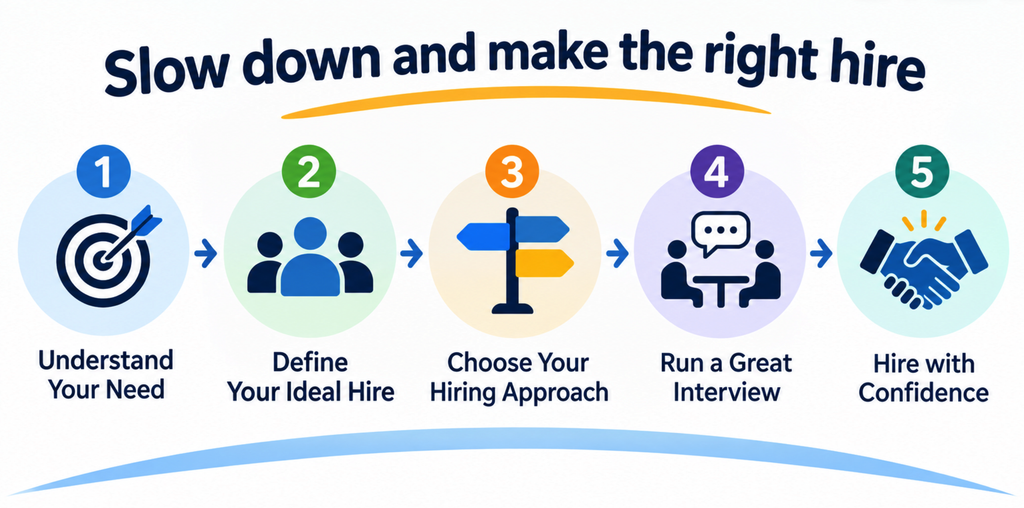
The Hiring Process: Four Steps to Finding the Right Salesforce Talent
Let’s bring everything together.
If you want to hire the best Salesforce professional for your organization, don’t start with a job posting. Start by understanding what you’re trying to accomplish.
Here’s the process:
Step 1: Understand the Business Need
Talk to your stakeholders, identify the problems you’re trying to solve, and define the outcomes you expect this person to deliver.
Step 2: Define the Ideal Candidate
Identify the technical skills, experience, certifications, working style, and cultural fit that will make someone successful in your organization.
Step 3/4: Evaluate Your Workload & Choose Your Hiring Approach
Determine how much work you actually have, whether it’s ongoing, and whether it justifies a full-time employee or a more flexible engagement.
Decide whether a full-time employee, freelance professional, fractional resource, or Salesforce consulting partner is the best fit for your needs.
By the time you’ve worked through these four steps, you should have a much clearer understanding of exactly what you’re looking for.
And that’s when you can start finding the right person.
Not just someone who checks the boxes.
Not just someone with the right certifications or the most impressive resume.
But someone who has the skills, experience, working style, and availability to deliver the greatest value to your organization.
Need Help Finding the Right Salesforce Talent?
You don’t have to figure all of this out on your own.
At Talent Stacker Staffing, we specialize in helping organizations identify and hire the right Salesforce talent through freelance, fractional, and full-time placements.
Whether you need an experienced Salesforce Administrator, Business Analyst, Developer, Architect, or a unicorn skill-set using specific Clouds, Integrations, AI and Agents we can help you understand your options and find the right person for your needs.
We would love to help you get started.
Email [email protected] to schedule a free call to discuss your need and make sure your confident with the direction your team is taking your Salesforce talent need.
We’ll help you evaluate and solidify your needs, determine the right hiring approach, and get you on the path to finding the best Salesforce talent for your organization.
The goal isn’t simply to fill a position. It’s to find the right person who will deliver the greatest value to your business, both today and in the long run.