The Annual Letter to the Salesforce Ecosystem | 2026 Edition
If you employee Salesforce talent as a customer, consultancy or app partner this letter is to you and for you. If you are a Salesforce talent I feel this is a good read, but it’s not written to you although there may be useful perspectives and information to take with you. Either way I hope you’ll enjoy.
Dear Salesforce Employers,
I want to share something with you that I think is worth paying attention to.
I’ve spent years working alongside Salesforce professionals at all stages of their careers. I’ve watched people break into the ecosystem, land their first jobs, become consultants, move into leadership, start freelancing, and sometimes leave companies they once loved.
I’ve also spent a lot of time talking with employers about finding, hiring, developing, and retaining Salesforce talent.
One thing I’ve come to appreciate is that employers and employees don’t always see the employment relationship the same way.
So, rather than give you another list of generic hiring, development and retention tips, I want to share what I’ve been hearing directly from the Salesforce community and offer some practical suggestions for what you can do with that information in the coming year.
I’m not pretending to have all the answers. Some of what follows comes from conversations with Salesforce professionals, some comes from my own observations, and some comes from a survey of our Talent Stacker alumni community.
But I think there’s a lot here worth discussing.
What actually keeps Salesforce professionals around?
I recently asked our alumni community a relatively straightforward question:
What is the MOST important thing that keeps you with an employer long term?
623 people responded.
Here’s what they said:
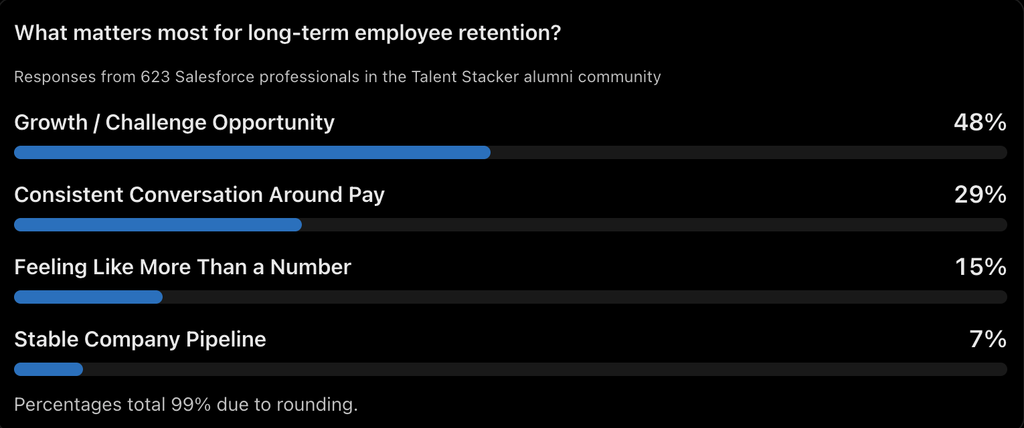
None of these answers are particularly shocking. In fact, they’re probably what many of you would expect.
But I think there’s a more interesting conversation to be had.
It’s one thing to know what employees want. It’s another thing to understand how to demonstrate that your company actually provides it.
Let’s talk about that.
1. Your employees are having career conversations. Are you?
We live in a world where people are constantly exposed to other people’s careers.
LinkedIn, Slack communities, Facebook groups, Discord servers, networking events, and the broader Salesforce ecosystem have created an environment where professionals are constantly learning what other people are doing.
Someone shares that they just landed a new job.
Someone else announces a $20,000 raise.
Another person gets promoted to architect.
Someone posts about getting laid off.
Someone else announces they’re making more money freelancing than they ever did as an employee.
These conversations are happening whether you participate in them or not.
And they influence how your employees think about their own careers.
One employee might go home worried about whether their job is secure after hearing about layoffs. Another might go home wondering how they can get that $20,000 raise they just saw someone else announce.
One is operating from a place of fear. The other is operating from a place of opportunity.
Neither is necessarily wrong. But both are being influenced by what’s happening around them.
Here’s where you as an employer have an opportunity.
Don’t wait for employees to come to you with concerns about their careers. Start having those conversations before they need to.
I would encourage every Salesforce consulting firm to establish recurring individual career conversations with its employees. Quarterly is a good starting point. Every two months can be even better if your team and management capacity allow it.
And I’d give those conversations some structure.
Talk about performance and the next level.
I want to make a small distinction here.
Instead of focusing your conversations on weaknesses, focus on opportunities for growth.
What is someone doing exceptionally well? What could they improve to take on more responsibility? What would it look like for them to become a senior consultant, lead a project, or move into a specialized role?
Don’t just tell someone what they need to improve. Help them visualize what’s possible if they continue progressing.
Give them a tangible picture of where you see them going.
Sometimes even knowing that their manager sees them as someone capable of taking the next step can make a significant difference.
Of course, that vision needs to be backed by real opportunities. Don’t promise promotions or titles you have no intention of delivering.
Talk about their next raise.
This is one of the most overlooked conversations in my opinion.
An employee shouldn’t have to guess what it takes to earn more money at your company.
If someone wants to move from $85,000 to $100,000, what needs to happen?
Does it require a new certification? Leading a project? Taking ownership of a client relationship? Demonstrating stronger technical skills? Improving utilization?
Give them something tangible to work toward.
And make sure those goals align with what your business actually needs.
People love getting certifications. They provide a sense of accomplishment and make individuals feel more marketable. But if you’re an employer, you should also be thinking about how to connect that learning to your business.
Can that certification help you deliver a new service? Can that employee take on work you currently outsource? Can they become the person who leads a particular type of implementation?
Now everyone wins.
I’m also a fan of more frequent compensation reviews. Annual reviews can feel like an eternity, particularly for ambitious professionals who are actively participating in the Salesforce community.
That doesn’t mean everyone needs a raise every three months. It means employees should understand when compensation is reviewed, what criteria are used, and what progress they’re making toward the next opportunity.
Talk about their bonus.
If your company offers annual bonuses, don’t make the bonus a conversation that happens once a year.
Make sure employees understand how their performance impacts it, what they’ve earned, and when they can expect payment.
For example, some companies structure bonus payments in installments rather than paying the entire amount at the end of the year.
There are different ways to approach this, but the important thing is transparency.
Don’t leave employees wondering whether the bonus is still coming, whether they qualified, or what they need to do to earn the next one.
Make it part of the ongoing conversation.
Talk about their next project.
This is especially important in Salesforce consulting.
Someone might be excellent at Sales Cloud implementations. You keep putting them on Sales Cloud implementations because they’re good at them.
That makes sense from a delivery perspective.
But what happens when that person starts wondering whether they’re becoming too specialized?
Talk about opportunities to shadow another project, participate in a different type of implementation, or take on a new responsibility.
Help them see that their experience is expanding, even when their primary responsibilities haven’t changed.
Talk about the company.
This one is important, particularly for smaller consulting firms.
Employees want to know whether the company is doing well.
They want to understand what you’re working toward, what opportunities you’re pursuing, and whether the business has a healthy pipeline.
You don’t have to share every financial detail or expose confidential client information.
But you can share things like:
- What types of projects are coming into the pipeline.
- What industries or services you’re investing in.
- What new partnerships you’re developing.
- What challenges the company is working through.
- What the next six or twelve months might look like.
And here’s the part I think gets overlooked:
Ask employees for their input.
Invite them to suggest improvements. Ask what they think about a new service offering. Let them share ideas about how the company could operate more efficiently.
When someone feels like their opinion matters, their relationship with the company can change.
They’re no longer just someone who completes assigned work. They’re someone helping build something.
2. Give ambitious people somewhere to go.
This is the biggest finding from the community survey, with 48% identifying growth and challenge opportunities as their most important factor in staying with an employer.
I think this is particularly relevant in the Salesforce ecosystem.
People enter this industry because they see opportunity.
They discover Salesforce, earn a certification, land their first job, and start building a career. They meet other professionals, learn new technologies, and discover entirely different career paths.
Some want to become architects. Others want to manage teams, specialize in integrations, become developers, or start their own consulting practices.
The ecosystem has a lot of directions someone can take their career.
Your job as an employer isn’t to make sure they never look at those other directions.
It’s to give them reasons to believe they can continue growing with you.
Here are a few ways to do that:
Give people exposure beyond their current responsibilities.
If someone spends all their time working on one type of project, give them opportunities to see something different.
Let an administrator shadow a developer. Let a consultant participate in a discovery call. Give someone the opportunity to observe how your architects approach technical decisions.
Create opportunities to lead.
You don’t necessarily need to promote someone to give them more responsibility.
Let them lead a client meeting, own a project deliverable, mentor a newer employee, or take responsibility for a particular area of an implementation.
Connect learning to actual career progression.
Certifications and training are great. But employees should understand how those accomplishments translate into opportunities at your company.
If someone earns their Platform Developer certification, what can they do now that they couldn’t do before?
If someone becomes more proficient with integrations, is there an opportunity to move into more complex projects?
Don’t let professional development become a collection of badges that employees earn on their own time with no connection to their actual job.
Give people some variety.
I know this isn’t always easy when you’re trying to keep projects staffed and clients happy.
But sometimes allowing an employee to spend a little time exploring something outside their specialty can pay dividends.
It makes them more versatile, helps prevent their experience from becoming too narrow, and gives them a reason to stay curious.
Here’s something worth remembering:
The best way to retain ambitious employees isn’t to prevent them from growing beyond their current role. It’s to give them opportunities to grow into their next role within your organization.
3. Compensation conversations shouldn’t be uncomfortable.
29% of respondents identified consistent conversations around pay as their most important long-term retention factor.
I want to spend a little more time on this because I think employers sometimes misunderstand what employees are asking for.
Not every conversation about compensation is a demand for more money.
Sometimes employees simply want to understand where they stand.
They want to know:
- Am I being paid fairly for what I do?
- What would it take to earn more?
- How does my compensation compare with someone taking on similar responsibilities?
- Does my employer recognize the additional value I’m bringing?
- Is there a path to the compensation I’m working toward?
These are reasonable questions.
And if you aren’t willing to have these conversations, someone else will eventually be willing to discuss compensation with them.
That someone might be another consulting firm, a recruiter, or a former colleague who just moved into a better-paying position.
I understand that employers have budgets, margins, and profitability to consider. Not every employee can receive every raise they request.
But there is a big difference between telling someone they can’t have a raise and leaving them completely in the dark about why.
Establish compensation bands where possible. Define what separates junior, mid-level, senior, and lead positions. Explain how performance, experience, responsibility, and business needs factor into compensation decisions.
And when someone earns a raise, make sure they understand what they did to earn it.
You want employees to see a relationship between their contributions and their compensation.
Not a mysterious annual decision made behind closed doors.
4. Don’t let your employees become a number.
15% of respondents identified feeling like more than a number as their most important retention factor.
This one can be particularly challenging as consulting firms grow.
When you have five employees, it’s relatively easy to know what everyone is working on, what they’re struggling with, and what’s happening in their lives.
When you have 50 or 100 employees, things change.
You have project managers, practice leaders, resource managers, delivery managers, and HR teams.
Somewhere along the way, an employee can start feeling like they’re simply a name attached to a utilization percentage.
I understand why this happens. Consulting is a business, and utilization matters.
But your employees are people, not just billable resources.
A few things that can help:
- Make sure managers know their employees beyond their current project assignments.
- Recognize accomplishments that aren’t directly tied to billable hours.
- Celebrate certifications, promotions, milestones, and personal achievements when appropriate.
- Give employees access to leadership and opportunities to share feedback.
- Make sure someone is checking in when an employee has been sitting on the bench or between projects.
- Don’t let the only time someone hears from management be when something goes wrong.
You’d be surprised how much a little intentional communication can change someone’s perception of their employer.
And this doesn’t require an expensive employee engagement platform or a massive HR initiative.
Sometimes it just requires managers to be more intentional about how they interact with their people.
5. Your employees want to know the business is healthy.
This was the lowest-ranked answer in the survey at 7%, but I wouldn’t dismiss it.
Especially in consulting, employees are aware that their job security is connected to the company’s ability to bring in work.
They see when projects end. They notice when new projects aren’t starting. They hear about layoffs at other firms.
And they talk to each other.
A company doesn’t need to have a perfect pipeline every month. That’s not realistic.
But employees should have some understanding of how the business is doing and how leadership is responding to challenges.
If your pipeline is healthy, talk about it.
If you’re investing in a new service offering, explain why.
If you’re experiencing a slower period, don’t automatically assume employees are better off not knowing anything.
There’s a balance between being transparent and creating unnecessary anxiety.
You don’t need to share every concern or every number. But you should be able to explain the direction of the business and why you believe in it.
And whenever possible, involve employees in the solution.
You might have someone on your team who has a great idea for a new service, a better delivery process, or a way to improve client relationships.
You won’t discover those ideas if everyone is expected to keep their heads down and bill hours.
6. A reality check for employers: You can’t win every comparison.
I want to add a little context here.
I’m not suggesting that employers should try to satisfy every expectation their employees develop.
There will always be someone earning more money, getting promoted faster, working on more exciting projects, or building a business on the side.
There will always be another opportunity.
And sometimes, despite your best efforts, an employee will decide that it’s time for something different.
That’s okay.
Your goal shouldn’t be to create golden handcuffs that make leaving difficult.
Your goal should be to create an environment where people genuinely want to stay.
You can have high standards. You can hold people accountable. You can expect employees to deliver quality work, meet client expectations, and contribute to the success of the business.
In fact, I think the best employment relationships are built on those expectations.
But employees should also feel that the company is holding up its end of the relationship.
Give people opportunities. Reward contributions. Communicate honestly. Help them grow.
You don’t have to be the perfect employer.
You just have to be intentional about being a good one.
What does all of this look like from the employee’s perspective?
Let’s bring this together.
Imagine an employee going home after a normal workday.
They’re sitting down to dinner with their family, and their spouse asks how work is going.
Instead of saying the usual “good, same old stuff,” they start talking.
“My manager and I had our career conversation today. We talked about my next raise and exactly what I need to accomplish to get there.”
“They’re going to let me lead part of the next implementation. I’ve been wanting to get that experience for a while.”
“Oh, and we talked about the company’s plans for next year. They’re investing in some new services, and they actually asked me what I thought about it.”
“I’ve got my annual bonus coming up, too. I know exactly what I’m getting and when.”
“I think I’m going to be able to move into that senior role sooner than I expected.”
That employee is going home feeling good about their employer.
They feel recognized. They feel challenged. They feel like they’re progressing. They understand how they’re being rewarded. They feel like they’re part of something.
And when they see someone else on LinkedIn announcing a new job or a big promotion or even unsettling news about layoffs, they might still be happy or fearful for that person.
But they’re not necessarily wondering why they’re missing out or if they might be next.
They have something good going on where they are, they have transparency as to where they stand.
That’s the difference.
A final thought to the Salesforce employers reading this.
I’ve spent a lot of time on the talent side of the Salesforce ecosystem, working with over 2000 unique professionals and over 600 employers to help with talent decisions, strategy and growth.
I’ve helped people break into this industry, find their first opportunities, develop their skills, and build careers.
I’ve also spent a lot of time talking with employers about their hiring challenges, their staffing needs, and the difficulty of finding the right people.
I recognize that building a successful consulting firm isn’t easy, that hiring the perfect internal team doesn’t come over night and that the people you hire may be the one biggest impact on the long-term success of your business.
You have clients to serve, projects to deliver, sales targets to hit, margins to protect, end users to serve and a team of people counting on you to get it right.
But I also think there’s an opportunity for employers to rethink how they approach the people who make all of that possible.
Your employees are having career thoughts and conversations every day.
They’re thinking about their next raise, their next certification, their next project, their next title, and their next opportunity.
You can either be part of those conversations or leave them entirely to the rest of the ecosystem.
I’d encourage you to be part of them.
And if you’re reading this as someone responsible for building a Salesforce team, I’d love to hear your perspective, too. What’s working? What are you struggling with? What have you learned about finding and keeping great people? Feel free to email me directly at Bradley at TalentStackerStaffing.com
Let’s have more of these conversations.
Bradley Rice
Talent Stacker Staffing
Helping Salesforce consulting firms find the talent they need to build and grow their teams.